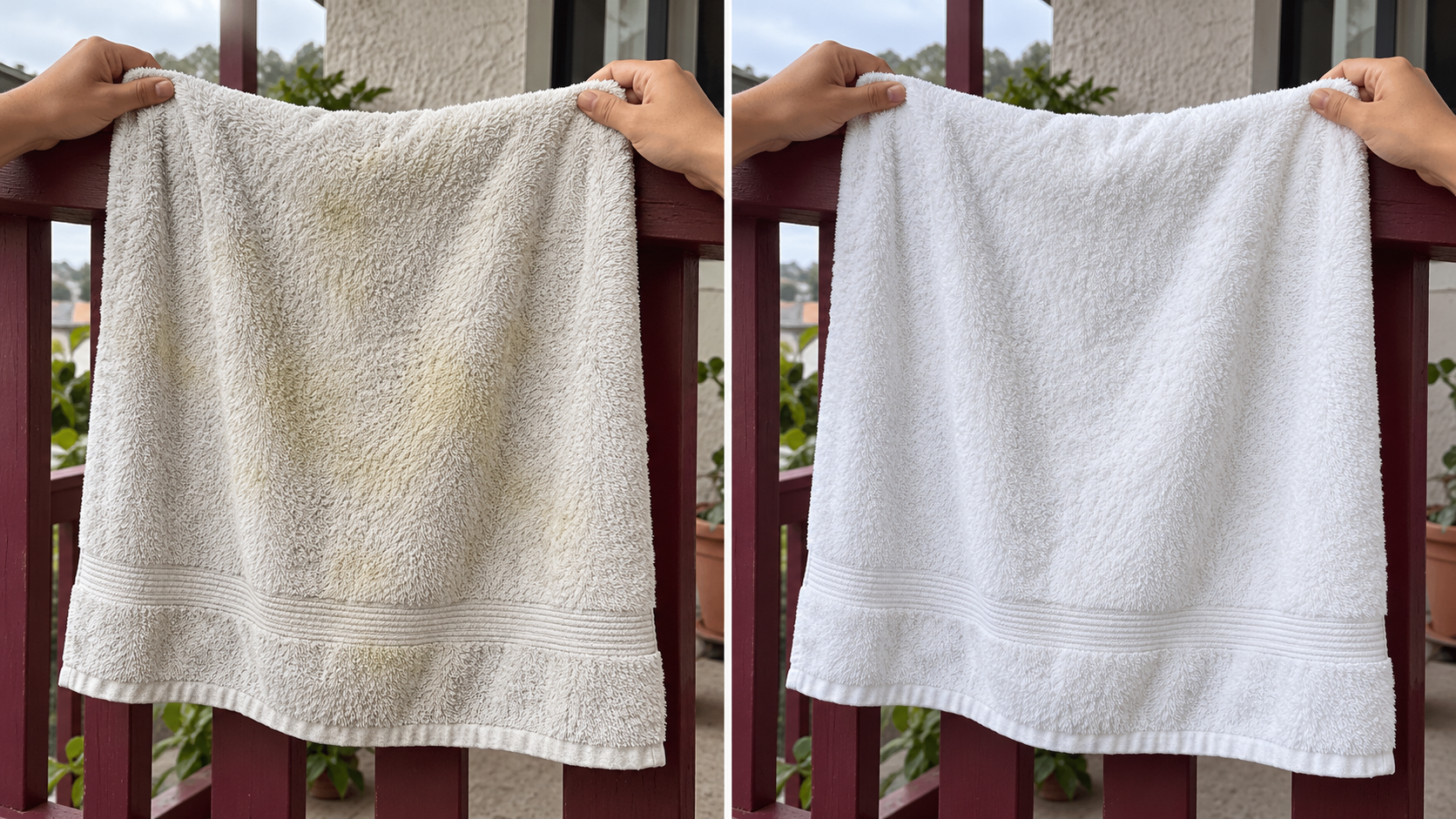
Rough towels: discover a routine without fabric softener
A useful trial begins with the normal detergent measured correctly and no fabric softener. Check loading, rinsing, and drying before assuming that a special additive is necessary. Judge the outcome by absorbency and the feel of completely dry fabric, not just by fragrance.
## Why towels become rough even when they are washed regularly
Rough towels can reflect detergent residue, fabric softener buildup, hard water, overcrowded loads, drying conditions, or ordinary wear. These causes do not all call for the same added ingredient. Start by thinking about when the texture changed. A new detergent, a larger load, or a switch from tumble drying to line drying can be more informative than a dramatic household cleaning claim.
A routine described as a hotel trick does not prove that one secret ingredient is responsible for soft laundry. Commercial laundries coordinate equipment, water conditions, dosing, and drying. The useful lesson at home is to make those stages work together. A towel can be clean but feel stiff after air drying, and a heavily scented towel can still contain unwanted residue.
## Read the care label before changing the wash
Check the fiber content and the instructions for temperature, bleaching, and drying. Cotton, blends, decorative trim, and specialty fabrics do not necessarily tolerate the same treatment. White fabric is not automatically safe for every bleaching product. A worn towel with thin areas also needs gentler expectations: washing cannot rebuild missing fibers or restore loops that have already rubbed away.
Separate white towels from strong colors and heavily greasy kitchen cloths from lightly used bath towels. Different soils may need different pretreatment and wash settings. New deeply colored textiles should not be mixed with whites. Check pockets and remove objects before loading. Simple sorting prevents problems that no after-the-fact whitening trick can reliably reverse.
## Match detergent to the load and the water
Use the detergent label to choose the dose for the load size, soil level, and water conditions. Extra detergent does not automatically produce cleaner towels. It may be harder to rinse away. Too little may also leave soil behind. Measure rather than adding a casual extra splash whenever a load looks large. If water hardness is relevant, information may be available from your water supplier.
Observe the machine’s capacity for the specific cycle. The largest advertised drum capacity does not apply equally to every setting. Tightly packed towels cannot move and rinse as intended. Split an overloaded batch instead of compressing it into the drum. When results worsen, check loading and dosing before adding another product that makes the routine harder to evaluate.
## Try a straightforward wash without fabric softener
Shake out the towels and choose the cycle permitted by their labels. Add an appropriate detergent in the measured amount and leave out fabric softener for the comparison wash. Softener can leave a coating that is undesirable on absorbent textiles. After drying, assess both the feel and the ability to take up water. A silky surface is not the only measure of a useful bath towel.
If detergent residue is a plausible issue, an additional rinse may help when the machine offers that option. It should not become a permanent substitute for correct dosing. Check the result after complete drying. Avoid changing every variable at once: if detergent, temperature, load size, and drying all change together, you will not know which adjustment made the difference.
## Treat dull whites according to the fabric
An oxygen bleach labeled for suitable white textiles may be an option for certain stains and discoloration. Check both the fabric label and the product directions. Some detergents already include relevant whitening ingredients, so an additional powder is not automatically necessary. Follow the instructions for dose, temperature, and where the product should be added.
Sodium percarbonate is sometimes promoted as a household shortcut, but it is still a chemical with use limits. It is not a universal treatment for delicate fibers, colored trim, or every fabric finish. Choose an appropriately labeled laundry product and use it as directed. Do not build an improvised mixture from multiple powders and liquids in the hope that more ingredients will create a better result.
## Handle kitchen cloths differently when grease is involved
Remove solid food particles before washing. Pretreat noticeable marks with a product approved for the fabric, following its directions. Avoid rubbing so aggressively that the weave becomes damaged. Soaking is an option only when the textile and the product permit it. Do not leave used damp cloths tightly crumpled in a closed container for an extended period.
Follow the dryer’s warnings about oil-contaminated textiles. A normal wash does not necessarily remove every trace of oil from a heavily loaded cloth. Do not place visibly oily items into a hot dryer and assume that washing made them safe. Address remaining contamination with an appropriate cleaning process. The desire for soft laundry should never override the appliance’s directions for safe drying.
## Drying has a major effect on texture
Remove towels promptly when the wash finishes and shake them out. For air drying, leave enough space for moisture to escape. A thick towel folded tightly over a short rail can stay damp in the middle long after its edges feel dry. Reposition it when needed. Store towels only when the seams and dense borders have dried as well as the main fabric.
If the label permits tumble drying, use an appropriate setting and avoid unnecessary overdrying. Movement in the dryer can leave terry cloth feeling more relaxed. That difference does not prove that a special wash additive was needed. Air-dried cotton may feel firmer while remaining clean and functional. Compare similar towels dried in similar ways before judging a change in your washing routine.
## Why vinegar and fragrance are not universal answers
Vinegar is not automatically approved for every washing machine. Materials and dispensing systems differ, and the appliance’s directions matter. It must never be combined with chlorine bleach. If hard water seems to be part of the problem, review detergent dosing and manufacturer-approved maintenance options first. An arbitrary quantity of acid in the softener compartment is not a substitute for that assessment.
Baking soda combined with vinegar may fizz, but visible bubbling is not evidence of a superior laundry process. Essential oils and heavy fragrance do not inherently improve absorbency and can leave unwanted residue. Keep the experiment simple: suitable loading, the right detergent, a measured dose, and complete drying. That makes the result easier to understand and the next adjustment more deliberate.
## Check the washer itself
Inspect the detergent drawer and accessible door seal for residue, then clean them according to the manual. Use any maintenance cycle as directed, including whether the drum should be empty and which product is allowed. A dirty dispenser can interfere with an otherwise sensible laundry routine. Avoid treating the machine as a container that never needs its own care.
Persistent odors, poor draining, leaks, or error messages deserve a separate diagnosis. Open a service filter only according to the appliance instructions, because water may escape. Covering an odor with additional fragrance does not remove its cause. Resolve the underlying issue so that every fresh load is not washed under the same unfavorable conditions.
## Questions about softer towels
### Can every old towel feel new again?
No. Missing loops, thinning fabric, and permanent color changes cannot be washed away. An improved routine may remove residue and make the towel more pleasant to use. Once the fabric is worn, repurposing it for a less demanding task may be more sensible than increasingly strong treatment.
### Should the water always be as hot as possible?
Choose temperature according to the care label, the soil, and the detergent. Hotter is not automatically better and may damage decorative components. Particular hygiene requirements call for an appropriate validated process rather than an improvised household recipe.
### How should I judge the results?
Check that the towels are fully dry, smell unremarkable, do not feel coated, and absorb water normally. Observe several comparable loads instead of relying on a single before-and-after photograph. Consistent improvement is more useful than a one-time effect that cannot be repeated.